Understanding the real decision facing small businesses
When small businesses look at laundry equipment, the decision is rarely just about the machines themselves. Instead, the real question behind renting vs buying commercial laundry equipment is how much risk, responsibility and cost uncertainty a business is prepared to take on.
For many first-time buyers, purchasing equipment outright can feel like the simplest option. However, once ongoing maintenance, servicing, repairs and compliance are considered, rental often becomes the more practical and predictable choice.
The upfront cost difference
Buying commercial laundry equipment usually requires a significant upfront investment. Even a modest setup can tie up capital that could be better used elsewhere in the business.
Renting, by contrast, spreads that cost into a fixed monthly payment. As a result, businesses can:
- Preserve cash flow
- Avoid large capital expenditure
- Budget more accurately month to month
For small businesses, this predictability can make a meaningful difference. This is particularly true in sectors where margins are tight or demand fluctuates.
Maintenance and repairs – who carries the risk?
Another key difference when comparing renting vs buying commercial laundry equipment is who takes responsibility when something goes wrong.
When equipment is owned outright:
- Repairs are unplanned and often expensive
- Downtime can disrupt day-to-day operations
- Service contracts and call-outs are charged separately
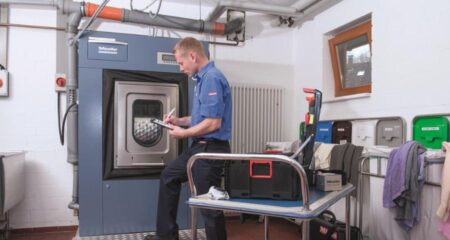
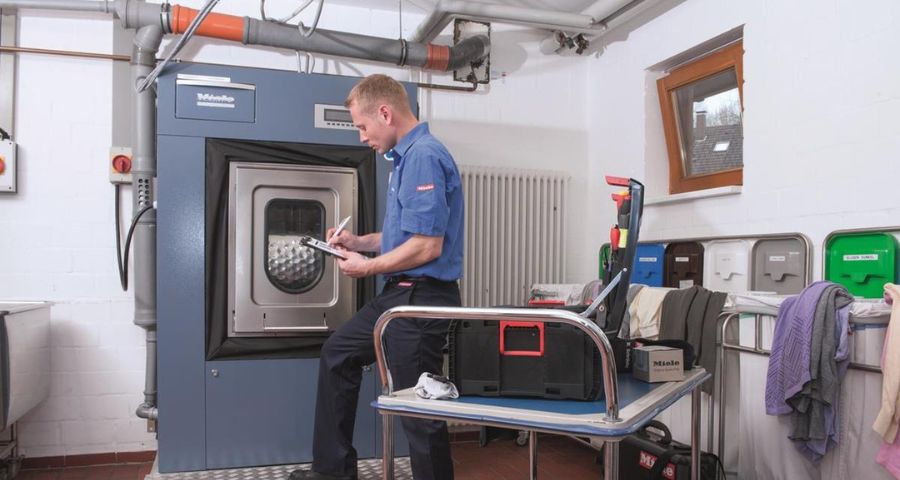
With a rental agreement, servicing and maintenance are included for the duration of the hire. Because of this, uncertainty is reduced and issues can be resolved more quickly by experienced engineers. In turn, businesses avoid unexpected costs and prolonged downtime.
Compliance and safety responsibilities
Laundry equipment is not just about performance. Safety and compliance also play an important role, especially where gas-powered dryers are involved.
Businesses that own their equipment remain responsible for:
- Mandatory annual Gas Safe inspections
- Ongoing compliance with Health and Safety requirements
- Managing duct cleaning and airflow safety
Although these obligations do not disappear, rental simplifies the process. A well-structured rental agreement ensures servicing, inspections and safety checks are planned and managed correctly. As a result, both risk and administrative burden are reduced for the business owner.
Flexibility as your business changes
Small businesses rarely stand still. Over time, growth, seasonal demand or changes in how laundry is handled can quickly make existing equipment unsuitable.
Buying equipment locks you into a fixed capacity and specification. Renting, on the other hand, offers greater flexibility and allows businesses to:
- Upgrade machines as demand increases
- Replace ageing or inefficient equipment
- Adapt layouts or processes without starting again
Because of this, rental is particularly valuable for businesses experiencing gradual growth or uncertain future demand.
Total cost over time
While buying may appear cheaper on paper, the total cost over time often tells a different story. Repairs, servicing, compliance, downtime and eventual replacement all add up.
When weighing renting vs buying commercial laundry equipment, rental offers:
- A fixed monthly cost
- No surprise repair bills
- Ongoing maintenance included
- Predictable budgeting
For many small businesses, this level of certainty outweighs the perceived savings of ownership.
Making the right choice for your business
There is no single answer that suits every business. However, for small businesses looking to reduce risk, control costs and avoid unexpected disruption, renting is often the more practical option.
By choosing a rental solution that includes installation, servicing, compliance support and ongoing maintenance, businesses can focus on running their operation rather than managing equipment.
Take the next step
If you are weighing up renting vs buying commercial laundry equipment, the best starting point is a conversation about your workload, space and future plans.