Commercial laundry maintenance is not just an engineer’s job
Commercial laundry equipment needs professional servicing, but the people using the machines every day also have an important part to play. A dryer taking longer than usual, a small leak around a washing machine or an unusual noise can all be worth reporting.
Good commercial laundry maintenance starts with knowing what is normal for your equipment. When something changes, staff are often the first people to notice.
Keep the machines clean and easy to inspect
Laundry rooms are busy working environments. Lint, detergent residue and general dust can build up surprisingly quickly.
Keeping the area around each machine clean makes it easier to notice leaks or other changes. It also helps engineers access the equipment properly when servicing is due.
Staff should follow the manufacturer’s instructions for any routine cleaning they are expected to carry out. This may include wiping accessible surfaces, keeping detergent areas clean or removing lint from filters designed for regular user cleaning.
Avoid letting laundry, boxes or cleaning products accumulate around the machines. Access points should remain clear.
It is a simple habit, but it makes day-to-day checks much easier.
Check dryer lint filters regularly
Dryer filters deserve particular attention.
Lint naturally collects as fabrics dry. If a filter becomes blocked, airflow can be restricted and drying performance may start to suffer.
Staff should clean accessible lint filters at the frequency recommended for the machine. In a busy laundry, that may form part of the normal working routine rather than something left until the end of the week.
A dryer suddenly taking longer to complete familiar loads is also worth noting. It does not automatically mean there is a fault, but it can be a sign that something needs attention.
Ducting and internal components are different. These should form part of planned professional maintenance and should never be dismantled or cleaned by untrained staff.
Look out for changes in washing performance
People who use the same washing machines every day quickly learn how they normally behave.
That makes staff well placed to notice when something changes.
A familiar cycle begins taking longer. Laundry may not be spinning as expected or the machine may start making a noise that was not there before.
Other things worth reporting include visible water around the machine, difficulty closing the door or repeated error messages.
These are observations rather than diagnoses.
Staff do not need to work out what is wrong. They simply need to recognise that something is different and raise it before the problem is allowed to continue.
Avoid overloading the equipment
Trying to squeeze more laundry into each load can seem like a way to save time. In reality, it can have the opposite effect.
Commercial equipment should be used within the capacity it was designed for.
An overloaded washing machine may struggle to clean and rinse properly. Laundry also needs enough room to move inside a dryer if it is going to dry effectively.
If machines are regularly being filled beyond a sensible level just to keep up with the workload, that may point to a capacity issue rather than a staff issue.
In that situation, it is better to review the laundry setup than ask the existing equipment to do more than it was designed to handle.
Pay attention when turnaround starts to change
One of the easiest signs to overlook is a gradual change in how long the laundry takes.
A dryer that needs an extra few minutes may not seem important at first. If that keeps increasing, however, the lost time starts to add up across a working day.
The same applies to washing equipment.
Staff should have a general idea of how long normal loads take. If familiar programmes are consistently taking longer or results are becoming less reliable, it is worth reporting.
Sometimes the cause will be straightforward. At other times an engineer may need to inspect the equipment.
Either way, noticing the change early is useful.
Know where routine checks should stop
There is an important difference between basic commercial laundry maintenance and technical work.
Staff can keep machines clean, empty user-accessible filters and report changes in performance. They should never remove panels, interfere with electrical components or attempt repairs.
Gas equipment needs particular care. Work involving a gas appliance should only ever be carried out by someone appropriately qualified and Gas Safe registered.
Planned servicing takes care of the bigger picture
Day-to-day checks help, but they do not replace professional servicing.
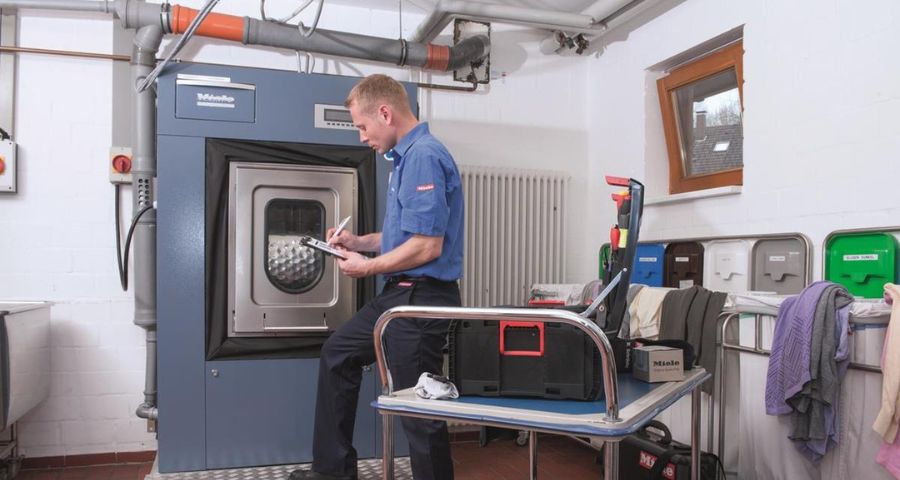
An engineer can inspect parts of the machine that staff cannot safely access. Planned maintenance can also identify wear, check performance and deal with developing issues before they interrupt the working day.
For businesses renting equipment from Laundry Rental Scotland, routine servicing is included within the rental agreement.
That matters because maintenance does not need to become another job for the business to organise separately. The equipment is supported throughout the term, with access to experienced engineers when technical attention is needed.
Staff can concentrate on using the machines properly and flagging anything unusual. The engineer takes care of the technical work.
Make commercial laundry maintenance part of the routine
Commercial laundry maintenance does not have to mean another complicated checklist pinned to the wall.
A few sensible habits go a long way.
Keep accessible filters clean. Do not overload machines. Notice when something changes and report it rather than waiting to see if it gets worse.
The professional maintenance remains exactly that – professional.
With a supported rental setup, servicing is already planned into the agreement. That gives businesses the reassurance of knowing their equipment is being looked after properly without asking staff to become maintenance engineers.
Laundry Rental Scotland provides commercial washing machines, tumble dryers and ironing equipment from trusted manufacturer partners. Routine servicing and ongoing engineer support are included throughout the rental term.
If you are considering commercial laundry rental and want maintenance and servicing included from the outset, request a quote and arrange a site assessment.